
BBA 2025 Winner Profile: Entrepreneur of the Year – KiFor
Written by Sterling Content
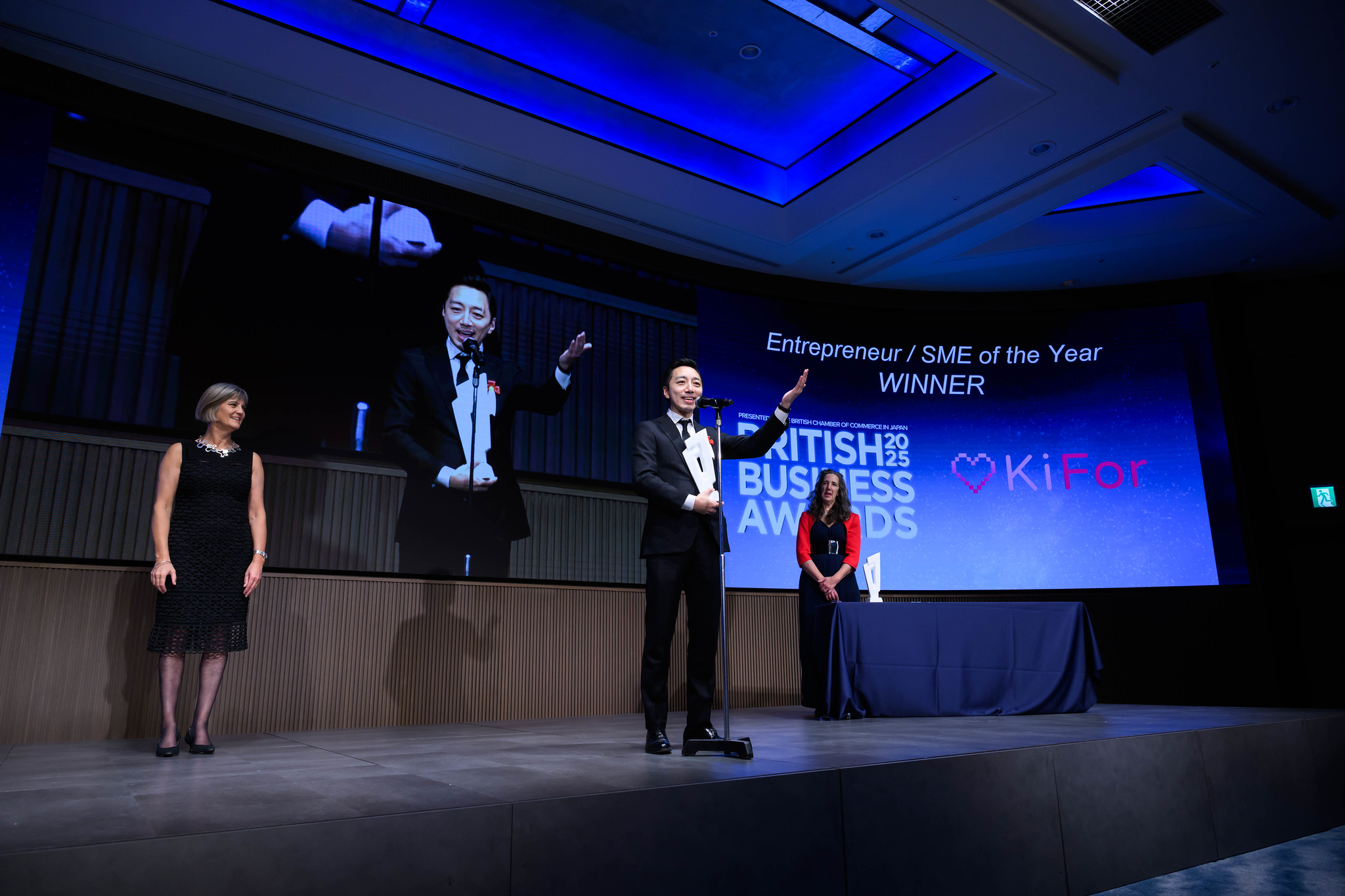
A year ago, KiFor existed only as an idea; founder Francis Fung envisioned a platform that could help him give back to communities in Japan. Now, the company has been recognised at the British Business Awards, the red-carpet gala of the British Chamber of Commerce in Japan, for exemplifying entrepreneurial spirit and creating commercial success.
Established in January 2025 as a Kabushiki Gaisha, KiFor delivers social impact workshops that allow companies to connect their teams with local charities. The sessions are designed to strengthen team culture, to boost engagement, retention and attraction of staff and to help companies stand out as purpose-driven workplaces.
Participants typically learn about social issues before designing and planning a project in which they can apply their skills to support a local cause. They then put the ideas into action in their own time to deliver results, which KiFor celebrates via project summaries and storytelling tools.
“I want participants to feel proud in using their skills for good, whether that means teaching single mothers how to type up a resume to pursue a better job or using AI to make posters to promote a fundraising event,” said Fung.
The charities that benefit from the participants’ skills and time have often been overlooked by the public, perhaps due to their small size, unregistered status, remote location or lack of visibility, he added.
Since operations began, KiFor has engaged more than 100 employees in workshops, for organisations such as the Rotary Club Tokyo Peace Wing. Together, their projects have supported children’s homes, food banks, child cafes, single parents and animal shelters.
Additionally, Fung has used LinkedIn and personal connections to fundraise more than ¥1 million for single mothers and the homeless and provide donated laptops and food boxes to children in institutional care.
All this is “proof that businesses in Japan can lead with purpose and social impact,” he said.
Inspired for change
Fung’s desire to play a more active role in the community was sparked in January 2024 when he began to wonder what impact his financial donations were having on the charities he was supporting. He began volunteering at a children’s home in Tokyo with YouMeWe, a not-for-profit organisation helping teenagers growing up in institutionalised homes to become independent adults. The experience exposed him to the challenges the children face and motivated him to explore how he could contribute more meaningfully.
Encouraged by a friend, he submitted a proposal for a startup accelerator programme and received a scholarship to join. His business idea was to create an app that would enable people to donate to small local charities through the touch of a button when making everyday purchases.
However, he soon realised that engaging with companies, rather than the public, could generate greater impact. He began offering workshops related to CSR; ESG; diversity, equity and inclusion; and the United Nations Sustainable Development Goals but, with limited uptake, switched to providing social impact workshops.
“The social impact workshops are a win for everyone involved: employees are happier and feel more satisfied in their roles; companies enjoy good PR and improved employee engagement, leading to less staff turnover; and charities gain access to valuable skills and time,” he said.
The name KiFor reflects Fung’s mission. Ki, which forms part of many words including kibo (hope), kifu (donation) and kizuna (connections), underscores the company’s social purpose. “For” signals that each activity is undertaken for someone: for single mothers, for children in care, for local communities.
Pivoting into rural revitalisation
In recent weeks, a foundation has asked KiFor to run a rural revitalisation project on Ishikawa Prefecture’s Noto peninsula, which suffered extensive damage in the January 2024 earthquake. Focusing on preventing traditional crafts from being lost, the initiative will centre around supporting the artisans of Wajima-nuri, a type of lacquerware renowned for its multilayered urushi (lacquer) mixed with powdered diatomaceous earth.
“In the 2024 earthquake, a lot of Wajima-nuri workshops were destroyed, and the infrastructure was decimated, resulting in a lot of artisans having to leave Noto,” said Fung.
Now, KiFor plans to offer revitalisation services to the area full-time. One idea is to create an art village in Noto where artisans can be supported financially to live, work and sell their crafts. A portion of proceeds would be donated to local charities, with the aim of building a sustainable ecosystem that attracts and retains local talent.
Domestic and international visitors could also be drawn to the area for tours and craft purchases, which would generate income and support additional roles such as childcare providers, guides and shop staff. With increased funds, more artisans could participate in the art village through funded residencies.
“We would create a self-sustaining cycle of doing art, selling art, attracting people to the community and then doing more art,” he said. “We may start on a small scale but if the model works, it can be replicated across Japan, such as in villages facing depopulation or in areas where artisans are getting too old to continue and do not have successors.”
Fung hopes the BBA win will serve as the launchpad for this new path for KiFor and is inviting corporate sponsors to support the project.
“I’m happy and surprised to win because the competition is at a high level; I was up against many other amazing entrepreneurs and businesses. And I’m excited about what the win might mean for the business going forward,” he said.
For more on KiFor, please visit www.kifor.jp